Irish manufacturers are under more pressure than ever to do more with less: tighter margins, labour shortages, and rising energy costs are pushing production teams to look seriously at automation for the first time. But “automation” covers a huge range of technology, from a single robotic arm to a fully integrated production line, and choosing the wrong starting point can waste time and budget.
This guide breaks down the main types of manufacturing automation solutions available to Irish producers today, what they typically cost, how to calculate ROI, and how to choose the right first project for your factory floor.
What Counts as a Manufacturing Automation Solution?
A manufacturing automation solution is any system, hardware, software, or both, that takes a manual or semi-manual production task and makes it run with reduced human intervention. In practice, this spans a wide spectrum:
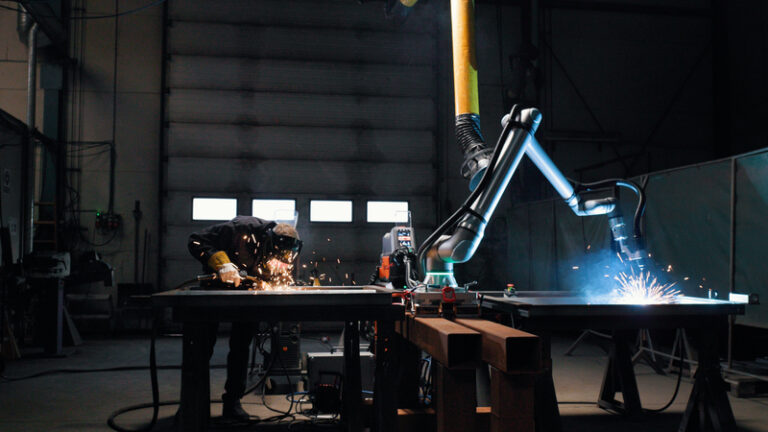
- Collaborative robots (cobots) that work safely alongside staff on assembly, packaging, or inspection tasks.
- Industrial robots for high speed, high volume operations like welding or palletising.
- Conveyors and transfer systems that move product between stages without manual handling.
- Feed systems and bowl feeders that automatically orient and present small parts.
- Linear motion and electric actuators for precise, repeatable positioning tasks.
- Vision systems that inspect for defects or guide robotic pick and place.
See our full range of automation products.
Most manufacturers don’t start with all of these at once. They solve one bottleneck first, prove the return, then expand.
Why Irish Manufacturers Are Automating Now
A few forces are converging at the same time:
- Labour availability. Recruiting for repetitive manual roles has become genuinely difficult across food and beverage, medtech, and general manufacturing in Ireland.
- Rising costs. Energy and wage inflation mean the cost of not automating keeps climbing.
- Competitiveness. Manufacturers competing internationally need the consistency and throughput automation provides to keep winning contracts.
- Lower entry cost for cobots. Collaborative robots have made automation viable for smaller production runs that couldn’t previously justify traditional industrial robotics.
Types of Manufacturing Automation Solutions (and When to Use Each)
| Solution | Best For | Typical Investment |
|---|---|---|
| Cobots | Low to medium volume, frequent changeovers, tight floor space | Lower entry cost, fast payback |
| Industrial robots | High volume, high speed, single repetitive task | Higher upfront, best at scale |
| Conveyors and transfer systems | Moving product between stages, reducing manual handling | Moderate, scales with line length |
| Vision guided systems | Quality inspection, defect detection, robot guidance | Moderate to high, depends on complexity |
| Linear motion and actuators | Precision positioning within an existing process | Low to moderate, often an add on to existing kit |
The right starting point depends on your production volume, changeover frequency, and where your current bottleneck actually is, not necessarily where it’s most visible on the floor.
How to Calculate ROI on an Automation Project
A rough but useful way to frame the business case:
- Cost avoided: labour hours saved, reduced overtime, lower error and rework rates.
- Output gained: additional units producible in the same shift pattern.
- Quality gained: reduction in scrap, returns, or customer complaints.
- Payback period: total project cost divided by monthly savings plus monthly output gain.
Most well scoped cobot projects in Ireland pay back within 12 to 18 months. Industrial robot lines vary more widely depending on scale and existing infrastructure.
Choosing the Right First Automation Project
A few practical rules that hold up well in real factory environments:
Start with your worst bottleneck, not your most interesting problem. The task causing the most downstream delay is usually the best ROI, even if it’s not the most technically impressive.
Pick a process with stable, well defined steps. Highly variable manual processes are harder, and more expensive, to automate well.
Involve the operators who do the job today. They’ll spot edge cases an engineer reviewing a spec sheet won’t.
Plan for changeover from day one if your production mix isn’t static. This is where cobots often outperform fixed industrial robots.
Explore Reliance Automation’s turnkey and bespoke solutions.
FAQ
It varies significantly by project scope, but a single cobot cell for a defined task typically starts in the low tens of thousands of euro, with payback often achieved within 12 to 18 months depending on labour savings and output gains.
Most manufacturers start by automating a single bottleneck step rather than a full line. This lowers risk, proves ROI quickly, and gives your team time to adapt before expanding further.
Cobots are designed to work safely alongside people without full safety caging, making them suited to lower volume or frequently changing tasks. Industrial robots are typically faster and better suited to high volume, single task production behind safety guarding.
A single cell cobot installation can often be commissioned in a matter of weeks. Larger integrated lines involving multiple robots, conveyors, and vision systems can take several months from design to full commissioning.
Reputable automation partners provide ongoing technical support, remote diagnostics, and on site service after commissioning. This is worth confirming before choosing a supplier, since automation systems need maintenance like any other production equipment.
Ready to Explore Automation for Your Factory?
If you’re weighing up where to start, talk to our automation engineers for a no obligation conversation about your specific production bottleneck.